1970 – 1990
Japan’s economy rapidly expanded throughout the 1960s period of high economic growth. Development of the country’s domestic infrastructure saw steady growth, while people’s lifestyles also greatly improved. By the 1970s Honda was setting its sights on markets outside Japan.
Honda had been exporting its power products since 1963. However, it was now beginning to formulate plans for what it called a ‘Million-Seller Engine’ (ME) for the international general-purpose engine market, which then totaled around 10 million units. With an annual production output of about 200,000 units, Honda was now planning to achieve annual sales of a million or more.
At the time, American-made general-purpose engines accounted for approximately 80% of the global market. These engines took advantage of the merits of mass production to sell at low prices. Yet problems persisted in terms of durability and maintenance.
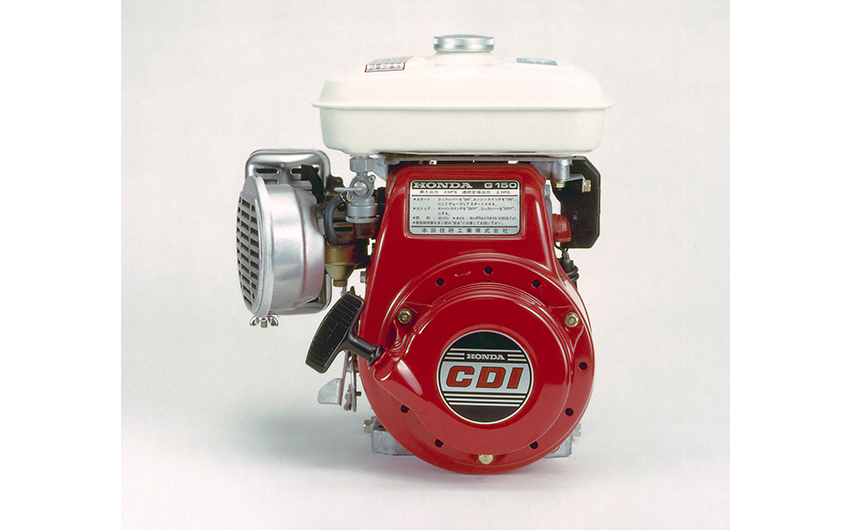
G150
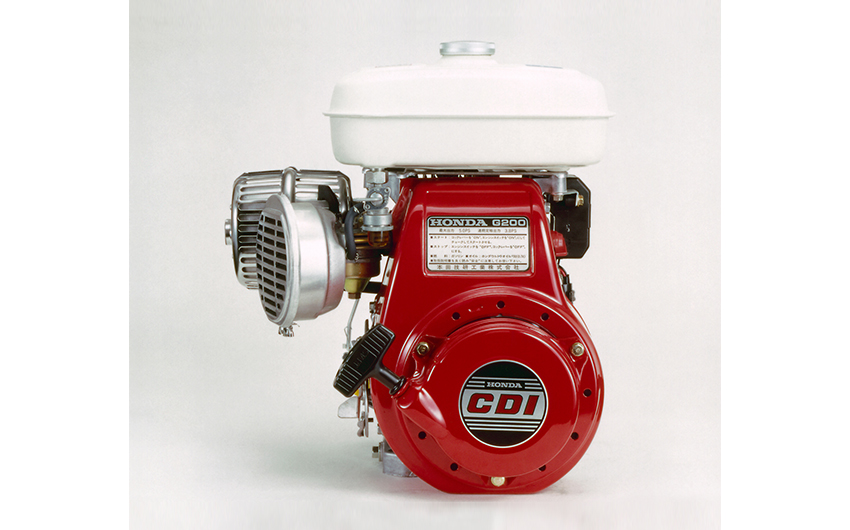
G200
Then, in 1977, Honda released its G150/200 general-purpose engine, the first developed under the new ME concept. The G150/200 incorporated new materials and new designs. With features like an automatic shutoff function for when oil volume was too low, a maintenance-free CDI ignition, a decompression cam for easier starts, and a kill switch for quick stops in emergencies, this engine successfully overcame virtually all of the weak points that plagued mainstream engines.
The G150/200 soon won a highly favorable reputation throughout Southeast Asia, where it became known as the red-and-white engine that steadily sold even when not displayed in the storefront, and found use in a wide variety of applications, including as an outboard motor and for powering pumps.
The engines developed under the ME concept eventually became a full lineup, and finally achieved the goal of a million units in annual sales by 1982. While this was only a tenth of the global market, it successfully showed the world Honda’s superior technological capabilities and vision.
Next on the horizon for Honda were lawnmowers for the US market. First, local needs were thoroughly investigated with detailed field surveys. Technology teamed up with novel ideas to overcome problems, and succeeded in creating a new line of high-quality products that offered excellent durability and ease of use. Honda’s hallmarks of quality were now extending to the United States.
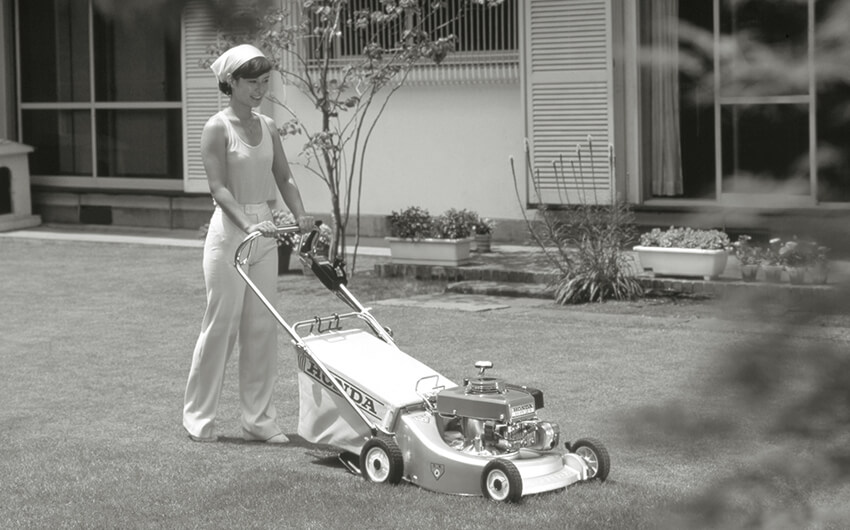
Not only performance but safety was considered in the development of the HR21 rotary lawnmower.
Having worked to solve the issues that most concerned customers, such as starting ease and performance, durability and quietness, these efforts culminated in the 1978 release of the HR21 walk-behind lawnmower, the first of its kind for Honda.
The HR21 was also equipped with a revolutionary safety device called the blade brake clutch (BBC) mechanism. With this mechanism the blades would only turn, and the lawnmower would only move forward, while the user gripped the clutch lever on the handlebar. Whenever the user let go of the handlebar, the blades would stop spinning within three seconds. American consumers had a strong desire to see safety devices incorporated into lawnmowers, but complicated technological obstacles prevented their adoption by existing models. Honda lawnmowers became an overnight success with US consumers, turning the HR21 into a major Honda product.
Honda’s challenge was not just developing and selling unfamiliar new products to unfamiliar countries overseas, nor limited to merely satisfying the needs of its customers, it was also determined to continue taking the initiative in pursuing technological advances. A prime example was the BBC mechanism developed for the HR21, which became a standard safety feature on lawnmowers across the US and made a notable contribution to society.
The next challenge was creating an engine for original equipment manufacturers (OEMs). OEMs produce products to be used in other companies’ brands. Nearly all power product engines are supplied by manufacturers OEM-style. OEM-supplied engines generally remained unchanged unless major problems developed, making it hard to get into the market unless some revolutionary technology was adopted.
The 1970s were rocked by oil crises and the US introduction of the Clean Air Act (also known as the Muskie Act) that instituted strict exhaust gas regulations and heralded a new focus on issues of energy conservation and greener products. Honda's automotive division had developed the compound vortex controlled combustion (CVCC) engine, which complied with the Clean Air Act and demonstrated Honda’s technological prowess to the world.
Now Honda set its sights on making general-purpose engines that would be powerful, fuel efficient, quiet, and environmentally friendly. Thus was born the Zillion Engine (ZE) concept — zillion simply meaning a limitless number.
At the time, the majority of general-purpose 4-stroke engines were of the simple side valve (SV) configuration. However, overhead valve (OHV) designs were vastly superior to SVs in regards to their power output, fuel efficiency, durability, quietness and reliability. The main problems with OHV engines were considered to be their increased size and larger number of parts. Honda boldly decided to take on the challenge of creating an all-new type of OHV engine.
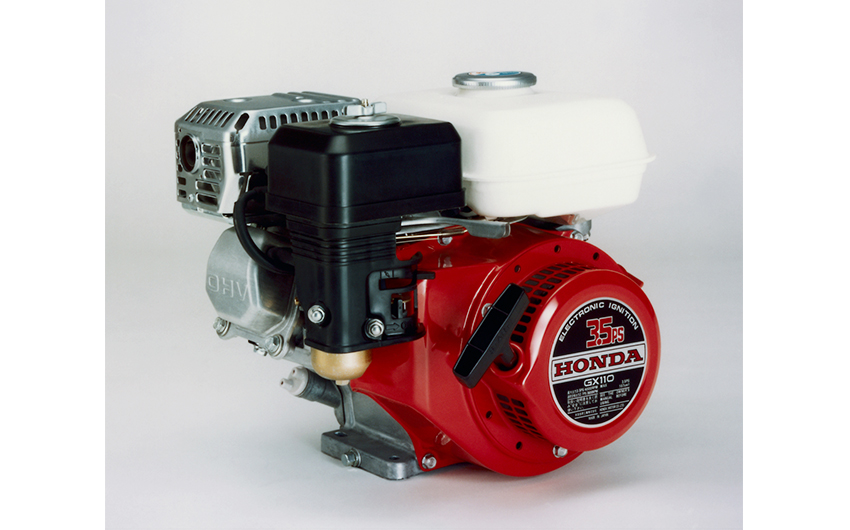
GX110
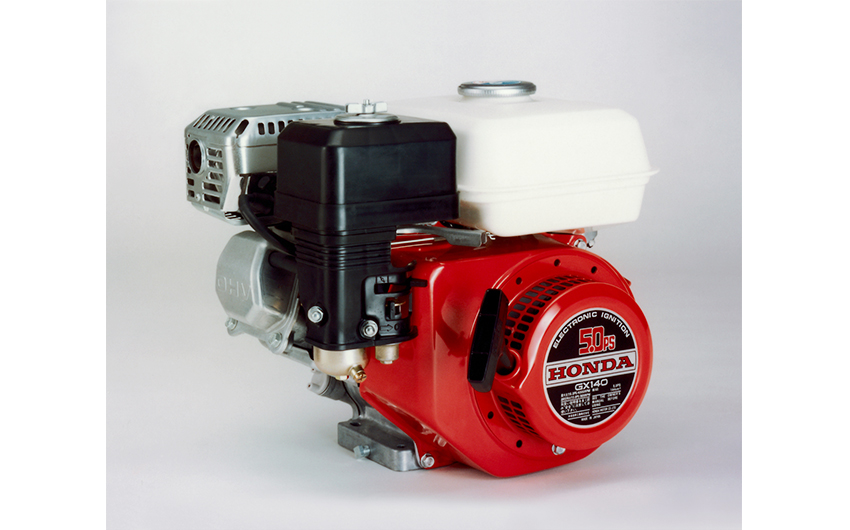
GX140
In 1983, the company released its GX110/GX140 engine. The GX110/GX140 achieved success with its inclined cylinder and consolidated parts. Every aspect of this engine surpassed the competition with not just with slight differences, but major leaps forward, while still managing to maintain a competitive price point.
The inclined cylinder design of Honda’s OHV GX series of general-purpose engines was eventually adopted by other manufacturers to become the industry standard for OEM engines, marking yet another revolutionary change to the industry.
By 1981, Honda’s total production output of power products reached the 5 million mark. It had taken thirty years to achieve this figure, yet in the space of the ensuing four years, that number shot up to over 10 million units. This major expansion in demand for Honda Power Products lead to the opening of a lawnmower plant in the USA in 1984. Production outside of Japan mushroomed, and soon spread to France in 1986, Thailand in 1987, Australia in 1988, and then on to India and other countries.
From the 1970s through to the early 1980s, Honda’s Power Products business undertook the challenges of new global markets. Its ability to create innovative products through its advanced technological capabilities as well as its innovative ideas and unique vision won the company a reputation for excellence worldwide, and established its high level of quality and durability as new standards for the industry. As it entered the 1990s, Honda would once again boldly rise to the challenge of surmounting the new hurdles it set for itself, all the while boldly challenging the new issues of environmental protection.