Snowthrowers
In Japan, a country that has half its territory regularly covered by heavy winter snows, the difficult work of clearing roads and pathways of snow had traditionally been done manually. Likewise, by the 1960s motorization had only just arrived in these snowy regions where horse-drawn sleds still provided much of the transport in winter, leading to the gradual introduction of powered snowplows to clear the main roads.
These large industrial machines were often noisy and difficult to operate, hence ordinary households still generally relied on manual shoveling to clear away the snow. However, Japan’s era of rapid economic growth saw a large migration of younger people gravitating toward the cities in search of jobs, further exacerbating the shortage of young men to clear snow in the off season. This left the backbreaking work of snow removal to the women, children and elderly who remained in the snowbound villages of the countryside.
In the United States, where virtually every home had at least one car, the use of compact snowthrowers for home use had already become widespread in snowy regions. In the mid-1970s, US snowthrowers began to be imported and sold in Japan, but though they could cope with light American snow, they were finding it difficult standing up to the wet and heavy snows of much of Japan.
By this time Honda was already building and selling a range of agricultural machinery and generators, advancing mechanization in order to lighten workloads. Seeing the importance of snowthrowers in helping to attain this goal, Honda began research and development of these machines in 1978.
But even within Japan the quality of snow differed from region to region, from the lighter and drier snows of Hokkaido to the wet and heavy snows found near the Sea of Japan. On top of this, snow could take many forms, from new fallen snow to compacted snow and snow that had fallen off roofs to powder snow. As part of its development of snowthrowers, Honda investigated all the different types of snow it could find, not just in Japan but also in Canada and even near the South Pole.
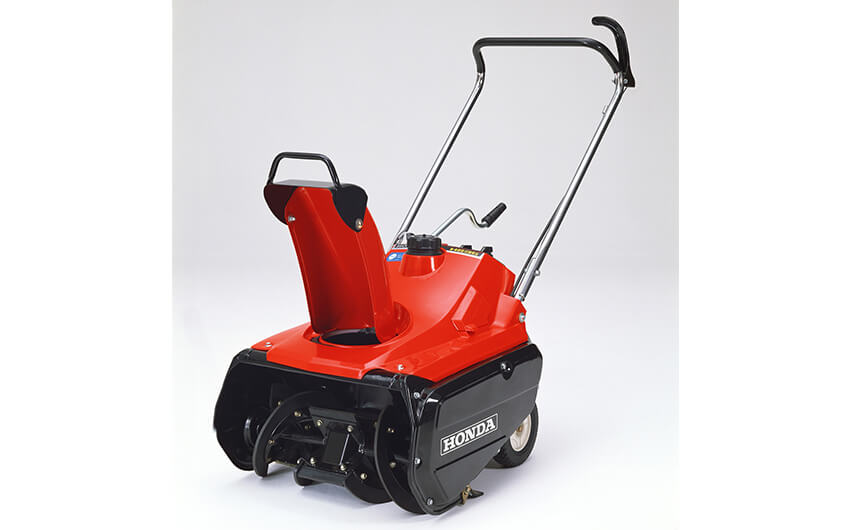
Honda’s first snowthrower, the HS35 Snowler, featured simplified operation for easier snow removal.
In 1980 Honda released its first compact snowthrower, the HS35 Snowler. This snowthrower operated by drawing in snow with a circular blade called an ‘auger’ and throwing it out of a discharge chute via an impeller called the ‘blower.’ The standard mechanism was generally of a rotary type, but Honda focused on the operating system and designed a much simpler set of controls. Once the user turned the engine on, all they had to do was grip a single clutch lever to make the machine draw in and throw out the snow, making it possible to remove as much as 30 tons of snow per hour. For safety, the auger and machine were both designed to stop moving if the user ever let go of the clutch lever. The HS35 Snowler’s folding handlebar also made it easier to store the snowthrower during the months when not in use, and its relative light weight of just 45kg further reduced workloads during the winter season.
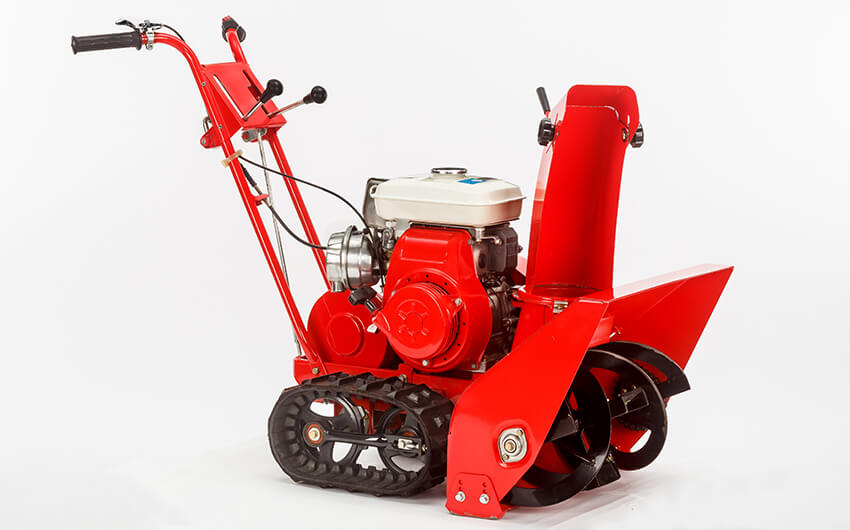
Released the following year, the S35A adopted crawlers for even more efficient operation.
Honda’s next challenge was to develop a snowthrower that would be able to work even more efficiently over wider areas. However, removing large volumes of snow required a lot more than mounting a big engine on a big chassis. For more efficient snow removal, Honda focused on the ability to adjust vehicle speed to match load requirements (or the amount of snow), and on where the snow would be discharged. Innovative techniques were continuously applied to simplify vehicle speed adjustment. And although a bigger auger could draw in larger amounts of snow, increasing the load, this would also greatly reduce engine speeds, sometimes causing it to either stop or ride up over uncleared snow. To avoid these situations, a way was needed to adjust vehicle speed while reducing the snow removal load in order to maintain higher engine speeds.
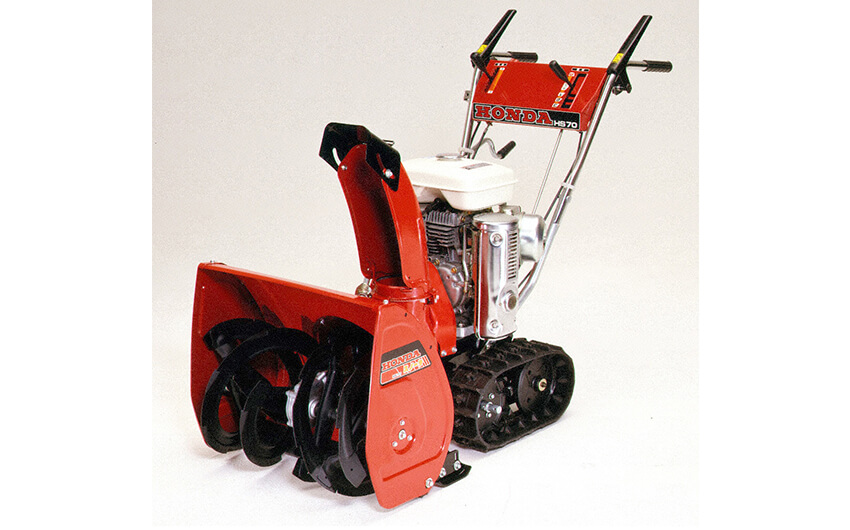
The HS70 Snowler featured 3 forward and 1 reverse gears.
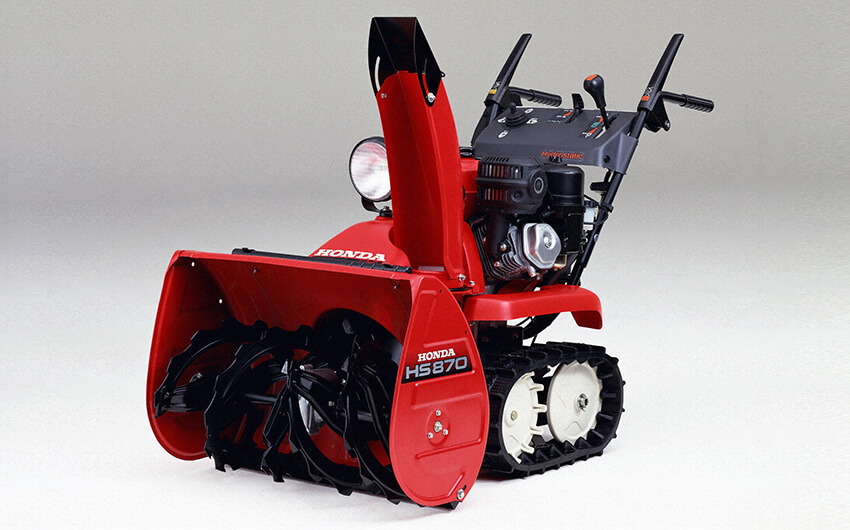
An HST (Hydrostatic Transmission) system was incorporated into the HS870 Snowler.
In 1984, the introduction of the HS70 Snowler solved these problems with a combination of 3 forward gears and 1 reverse gear. Its clutch design allowed users to easily shift between the 3 gears to adjust forward speed. The HS870S and HS660S Snowler models released in 1989 further introduced hydrostatic transmissions (HST) to allow users to adjust the machine’s speed continuously, forward and back, by way of a single lever, and without having to bother with a clutch.
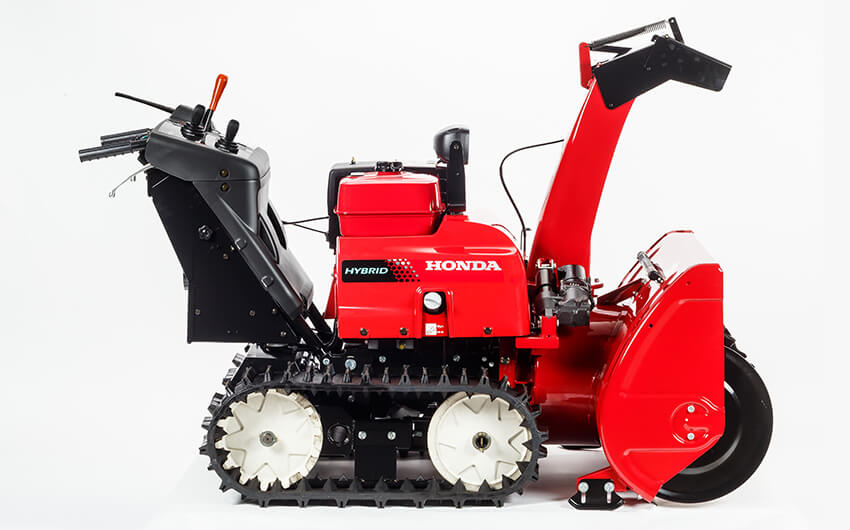
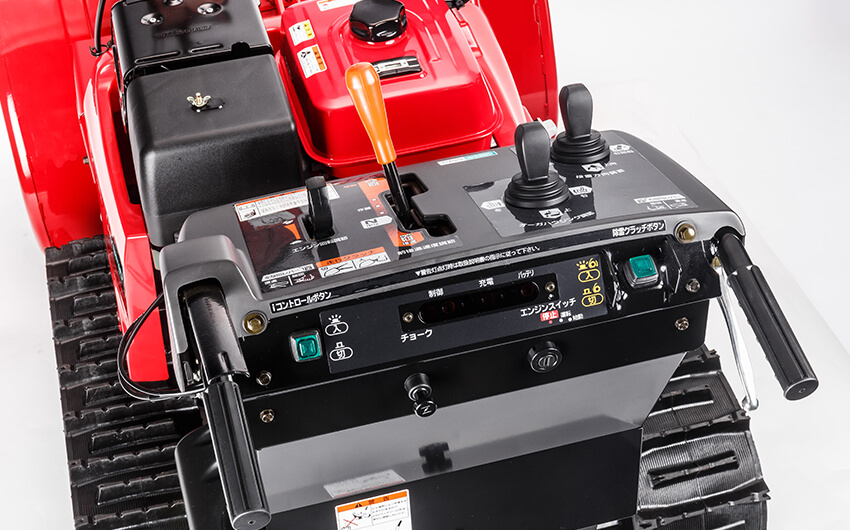
The HS1390i Snowler-i, the world’s first hybrid snowthrower.
Then, in 2001, the mid-sized HS1390i Snowler took another step forward by employing the world’s first hybrid system designed for snowthrowers. This hybrid model only used the engine for the actual function of snow removal, while its two electric motors, installed on either side, provided the machine’s forward and backward motion. Continuously monitoring the load on the engine, the HS1390i’s main ECU (electronic control unit) also simultaneously controlled the track drive’s electric motors, automatically adjusting its speed accordingly. These electric motors also provided smoother motion and easier turning capability.
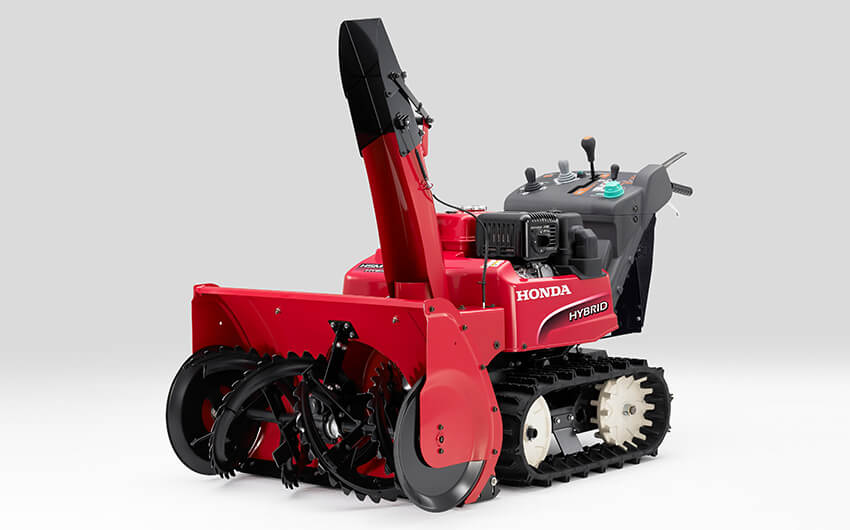
The HSM1590i Snowler-i represented a further evolution of the hybrid snowthrower.
The mid-sized HSMI1590i introduced in 2005 was equipped with Honda’s next-generation iGX engine, which was the first to utilize a digital ECU (Electronic Control Unit) to control its operation. Using this ECU for both engine control and mutual communication with the ECU controlling the electric motors in the chassis, enabled smoother speed adjustments with no time lag.
A single dial allowed the user to easily select from three modes of operation: an Auto mode that automatically controlled both forward speed and engine rpms, a Power mode that maintained the engine at maximum output for jobs that required more power, and a Manual mode that provided conventional manual snowthrower operation. This ensured that virtually everyone from beginners to more experienced users could run the machine, whatever the task or one’s operating skill levels.
Over the years, Honda has also introduced an assortment of new technologies specifically for snowthrowers. As rotary-type snowthrowers tend to use nearly 70% of their engine output for the actual act of ‘throwing’ the snow from the blower, a critical element of operation was to allow the throwing distance and direction to be adjusted while aiming at a particular point, while also constantly checking for safety in the surrounding area. The 1984 HS70 Snowler used a two-stage system that separated the ‘auger’ from the ‘blower,’ thereby extending the throw range to up to 12 meters.
In 1989, the HS870S and HS660S adopted a single lever to allow rapid, high-accuracy positioning of the throwing direction and angle, for a fully remote-controlled snow chute. Combined with its novel square-shaped throwing outlet, this extended the throwing distance even further. Honda’s latest HSL2511, introduced in 2017, has even achieved a maximum throw range of up to 26 meters.
The automatic speed adjustment featured in Honda’s hybrid models synergistically enhances safety and efficiency to allow users to concentrate more on the actual function of throwing the snow. The engine’s ECU control helps maintain a constant engine speed for more consistent throwing distances. This means that users no longer have to continually adjust the throwing distance by hand, further making machine operation that much easier.
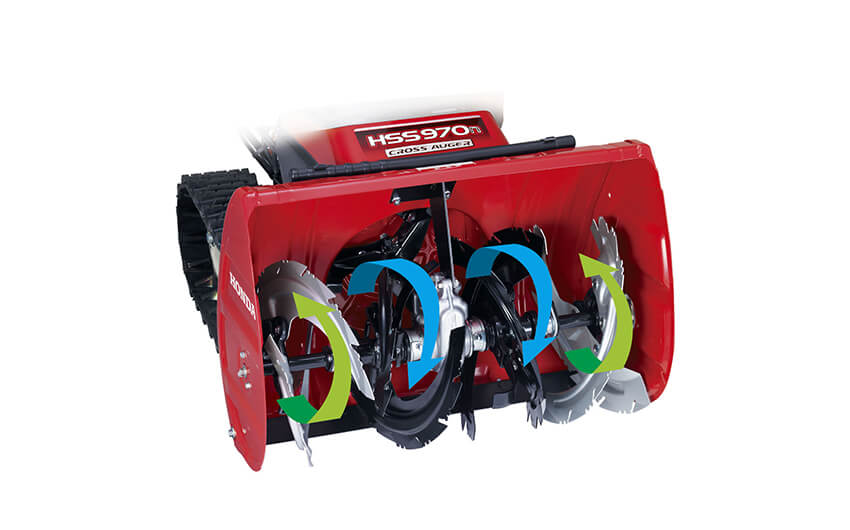
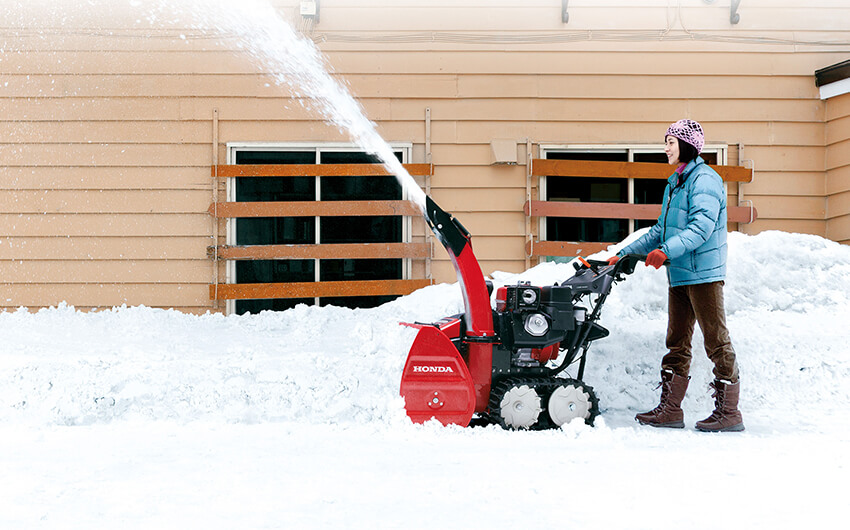
The HSS760nJX snowthrower utilized tiller technology to further enhance its snow-clearing capabilities.
Further, in 2013, Honda’s new HSS760nJX, HSS970nJX, and HSS1170nJX snowthrowers were the first in the world to incorporate Cross-Auger technology. A refinement initially developed for Honda’s ‘Salad’ lineup of front rotary tillers, the Cross-Auger features counter-rotating inner and outer rotary blades.
When working on highly compacted snow, or snow that has fallen from rooftops, conventional snowthrowers tend to rise up over the surface of the snow due to the reactive force of the auger. In such cases, ordinary augers can only gradually clear the snow by repeatedly being moved backwards and forwards over the surface. Conversely, the Cross-Auger’s dual clockwise and counter-clockwise auger rotation helps to limit this reactive force to prevent the snowthrower from riding up onto the snow, thus enabling it to clear away even hard-packed snow with a consistent motion.
In 1995, Honda added the HS2512Z Snowfighter, a large-capacity snowthrower that offered top-level snow removing capabilities, to its snowthrower lineup.
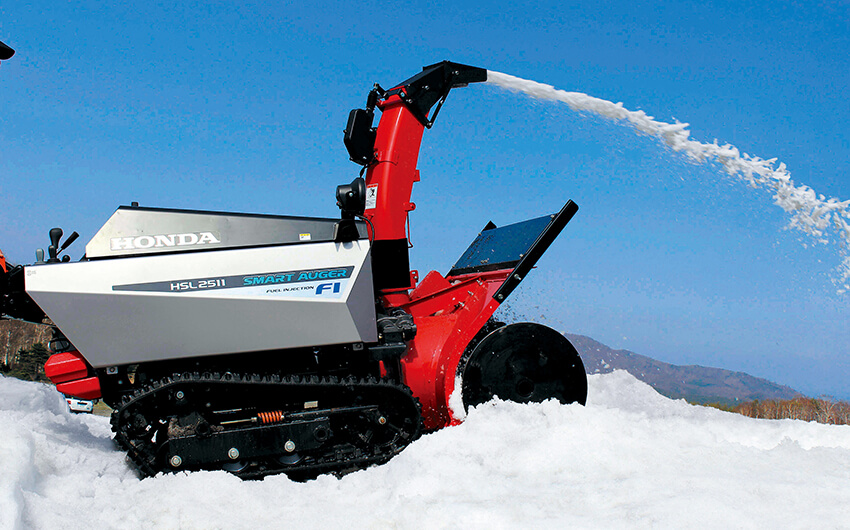
The large-capacity HSL2511 snowthrower incorporates the world’s first Auger Assist System.
Then, in 2013, Honda released it latest model, the HSL2511, which incorporated the Auger-Lift function featured on the mid-sized 2005 HSM1590i. This function automatically lifts the auger when the drive lever is put into reverse, then returns it to the same operating height when returned to forward drive again. It also features an Auger Reset button that enables the auger position to be returned to a preset position or placed in an absolute horizontal position at the touch of a button.
Further, its Auger Assist function automatically compensates for any tilting of the snowthrower by moving the Auger in whatever direction necessary to maintain an even level for snow removal. Together, these three functions combined to create the world’s first Smart Auger System. This HSL2511 was also the world’s first gasoline-powered snowthrower to adopt a computer-controlled fuel injection system for easier starting and low fuel consumption even in freezing temperatures.
For small amounts of snow, or locations where a snowthrower can’t be used, Honda’s lineup has been further enhanced by addition of two more models. The Yukios SB800 is a compact and easy-to-use blade-type snowplow that can push snow to a more out-of-the-way location. The Yukios-e is another compact blade-type snowplow, but with an electric drive system that can be charged from any home electrical socket. It’s operation is also extremely quiet, making it perfect for early morning or late night use.
Honda’s snowthrowers have continually reflected user preferences and requests, innovatively putting technology to use to simplify difficult jobs. Honda’s complete lineup of red snowthrowers all share the same quiet operation, safety, durability, and superior environmental performance of other Honda Power Products, and consistently maintain a top share in both Japan and world markets.
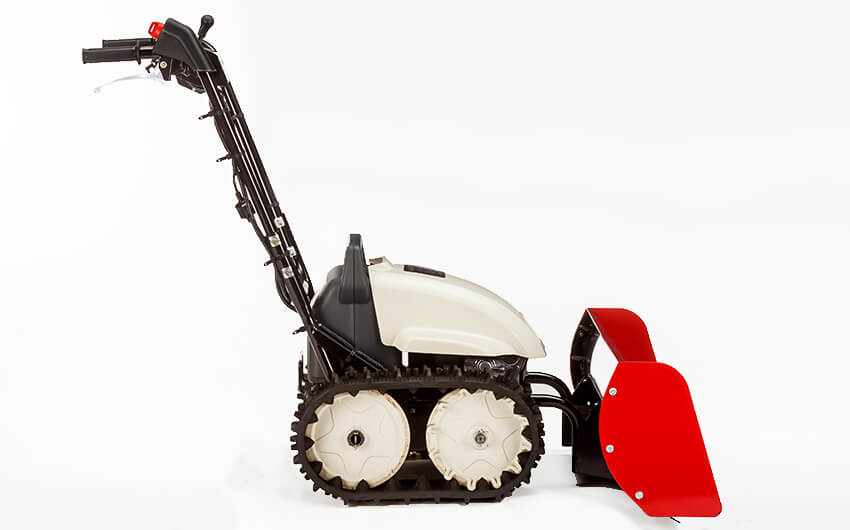
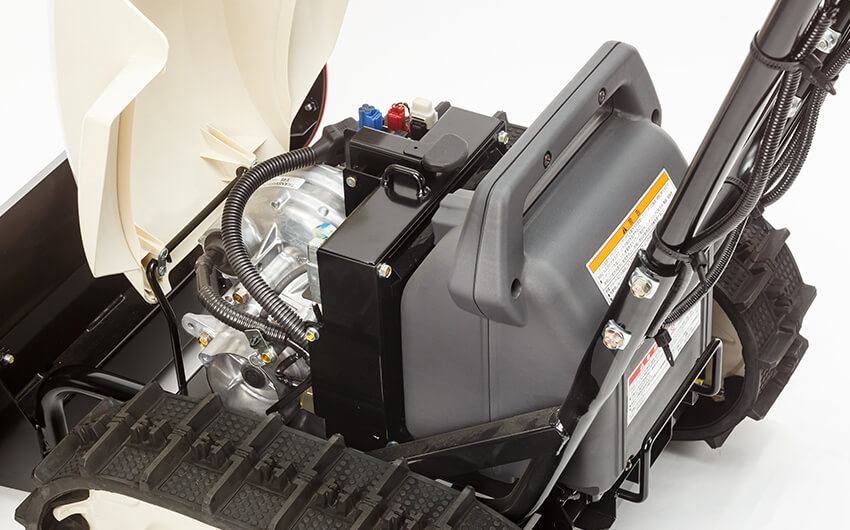
The electrically-powered Yukios-e snowthrower can be easily charged from a standard home electrical socket.