Handheld Power Tools
Handheld power tools like trimmers, chainsaws, blowers, and sprayers are used all over the world. The term ‘handheld power tools’ is generally used to describe tools that are equipped with motors or engines to give support to human power. The global market for these tools exceeds 40 million units annually (2013 figures), of which 47% are cutters (such as lawnmowers).
The most important factors determining the engines used in these handheld devices, regardless of whether they’re for commercial or home use, is their size and weight, so they need to be as compact and lightweight as possible.
Released in 1953, Honda’s first general-purpose engine was the H-type, a 2-stroke engine developed specifically to power a backpack sprayer, a device that falls into the handheld power tools category. The H-type’s development emphasized a compact, lightweight design in order to lighten the burden for the worker. Its use of aluminum die-cast parts was ground-breaking at the time, and made the H-type a pioneering example of a lightweight handheld engine.
On the other hand, the 4-stroke T-type general-purpose engine Honda released the following year was designed for rugged durability and better fuel economy to power farm machinery, rather than as an engine to be used with handheld devices.
Generally speaking, the engines used for handheld power tools have primarily been 2-stroke models, as their simpler designs and smaller number of parts make them lighter and more compact. Also, due to their unique fuel mixture of gasoline and oil, 2-stroke engines don’t require separate lubrication systems, making it possible for them to be used while tilted at different angles, perfectly fitting the needs of handheld power tools. This fuel mixture of gasoline and oil also provides ample lubrication to the 2-stroke engine so that it can continue to operate unimpaired at whatever angle it’s held.
4-stroke engines, on the other hand, have always been designed to be lubricated by a separate reservoir of engine oil that has usually been held in the crankcase sump, which means they could often seize if tilted beyond a 30° angle. These engines also have relatively complex and heavy geartrains to operate their valves, so the general consensus for years was that 4-stroke engines were not suitable for use with handheld power tools.
Clearly, 2-stroke engine won out for their lightness and usability, but they still had much need for improvement: notably in regards to their poor fuel economy, excessive noise and vibration, and in particular their smelly gas fumes, which were usually accompanied by billowing plumes of white smoke. Also, in 1996, the California Air Resources Board (CARB) released its Small Off-Road Engine (SORE) exhaust emissions regulations, which required that a catalyzer or similar air purification device be attached to 2-stroke engines, due to their excessive exhaust gas emissions.
The enactment of these exhaust emissions regulations spurred Honda to specially develop a 4-stroke engine to be used with handheld power tools that could help people and the world, as well as the future with its technology. The result was the M4-1 engine (meaning the first Mini 4-stroke engine) designed to offer the same usability as a 2-stroke.
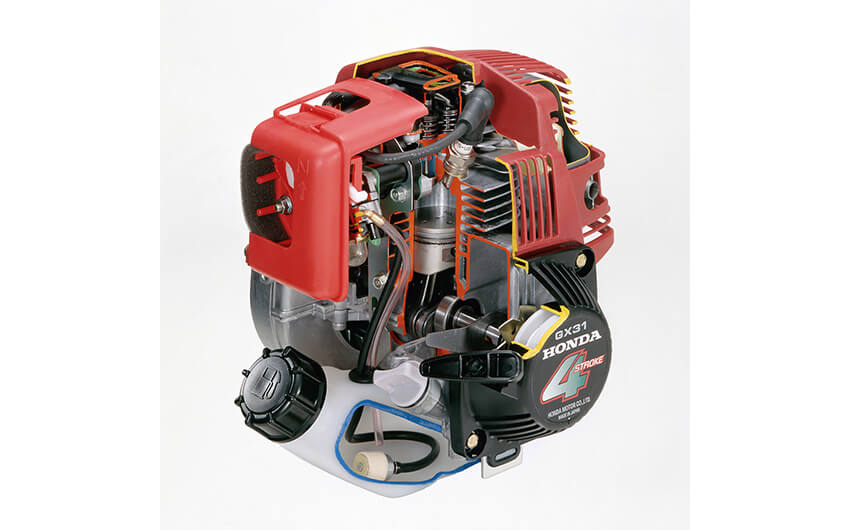
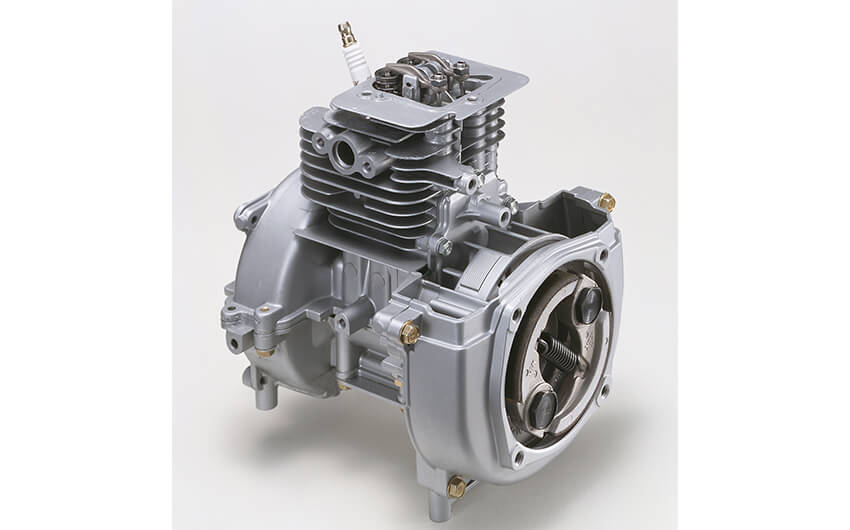
Honda technology resulted in a super-compact 4-stroke engine.
Honda overcame the challenge of lightening the 4-stroke engine by developing an overhead valve (OHV) configuration that utilized a single plastic cam to downsize and lighten the valvetrain. It also adopted a lightweight high-silicon aluminum Uniblock cylinder with a sleeveless design that eliminated the usual heavy iron cylinder sleeve. The engine’s 3.3kg dry weight helped it achieve compactness on the level of a 2-stroke engine.
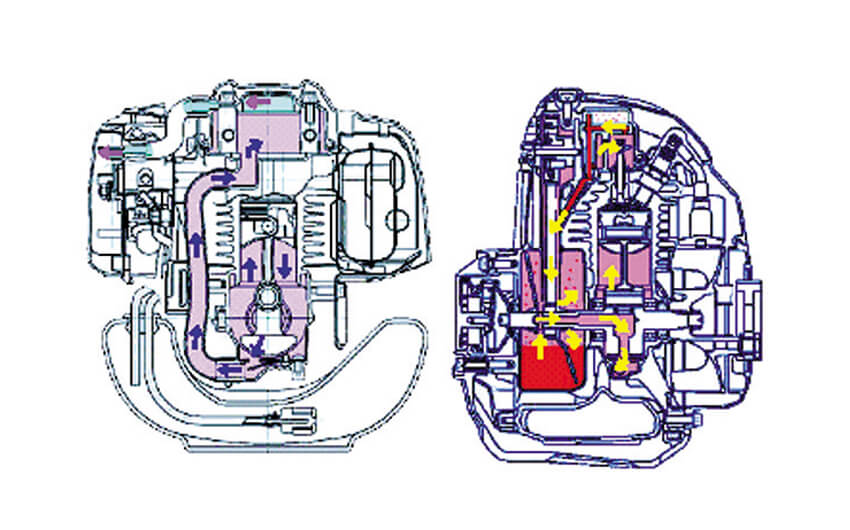
The biggest problem in the design of this new 4-stroke engine was lubrication, which was successfully solved with the development of a new technology called the ‘Rotary Slinger Pumping Lubrication System.’ The design uses a dry sump lubrication system that separates the oil reservoir from the crankcase to prevent oil from entering the combustion chamber, whatever angle the engine is tilted.
The piston’s reciprocating motion generates pressure pulses inside the engine’s crankcase that work like a pump to draw oil in from the external oil tank through suction ports in the crankcase. Impellers attached to the crankshaft then splash the engine oil around inside the engine to provide needed lubrication. This new technology made possible—for the first time ever—a 4-stroke engine that can be rotated 360° with no ill effects.
The new engine cleared US Federal EPA and CARB exhaust emissions regulations with ease, and without need for any ancillary post-processing devices like catalyzers. Together with its incredible fuel economy, the M4-1’s superb environmental performance gave testament to the technological advancement of Honda engines.
The M4-1 engine was released in 1997 as the GX22 (22.2cc; 1PS/7000rpm) and the GX31 (31cc; 1.5PS/7000rpm). These
engines were used in various Honda Handheld power tools, like the UMK422 & UMK431 Karimaru 4 trimmers and
brush cutters, and the WJR2210, 2215 and 2225 backpack-style power sprayers.
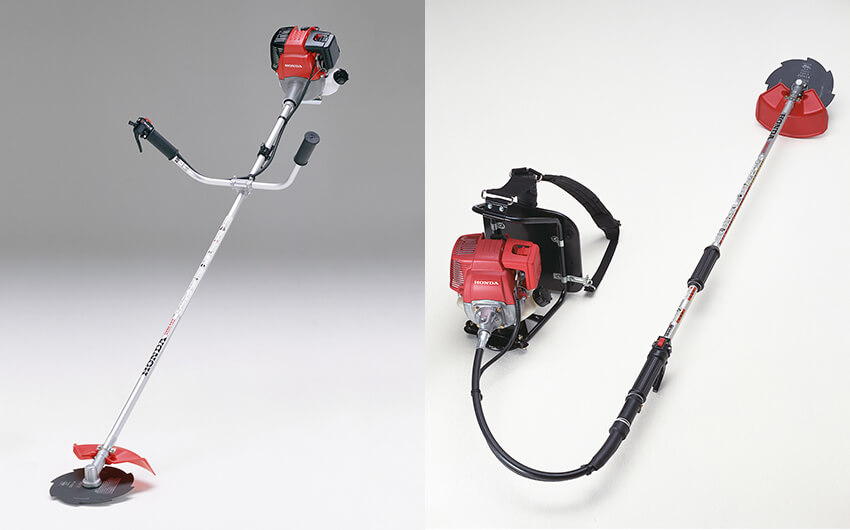
The UMK422/UMR422 Karimaru 4 Trimmer
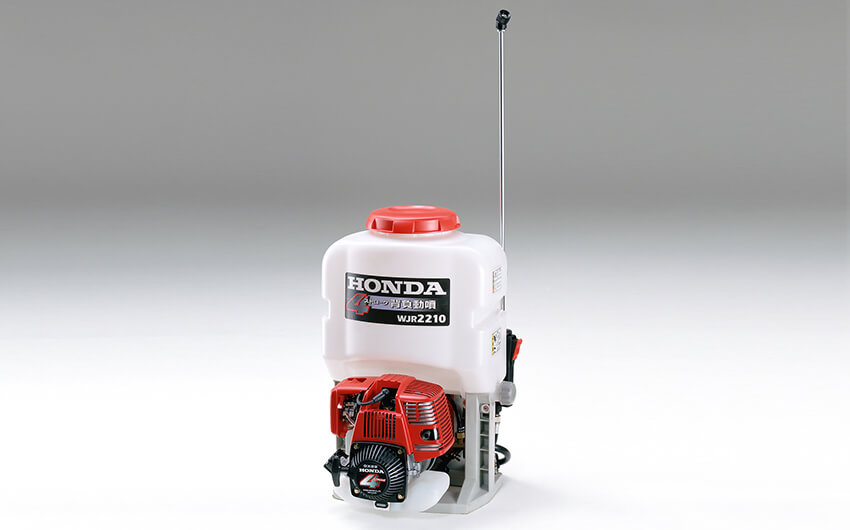
The WJR2210 back-pack power sprayer
From the beginning, Honda has also paid close attention to the safety of the users of its handheld power tools, supplying items like safety glasses (or goggles), which are needed when using such equipment as trimmers, as standard accessories. The inclusion of safety goggles later became a standard feature for trimmers throughout the industry, but Honda actively focused on the safety of these devices from its very first models.
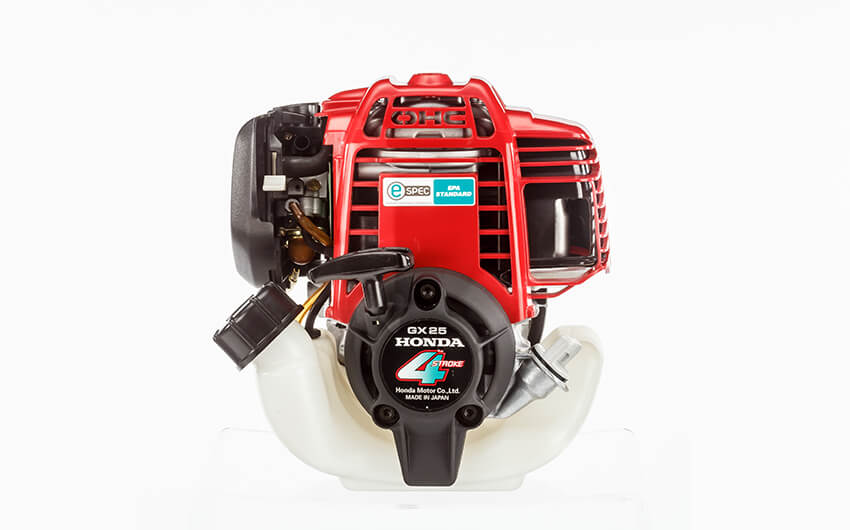
The GX25 achieved its remarkably small size and light weight due to features like its OHC configuration.
Honda’s first generation of 4-stroke handheld engines, the GX22 and GX31, were also supplied as OEM engines to numerous manufacturers of handheld power equipment, and went on to become record-breaking hit products with total sales of over 1.2 million units.
Several years after the release of the M4-1 engine, Honda began work on the M4-0, aiming to further increase its power and lower its weight in response to user requests. Repositioning the oil chamber and valve chamber, essential to a 4-stroke engine, in a centralized layout was also key to achieving the engine’s smaller size and lighter weight. Honda’s unique overhead camshaft (OHC) design, featuring a newly developed ‘world’s smallest timing belt,’ was further added to create a unique framework. Engine displacement was also increased (from 22.2cc to 25cc) to improve the power-to-weight ratio by 30% (relative to the M4-1), and succeeded in greatly enhancing the new engine’s appeal.
On top of this, the new model achieved the highest ratings in the United States Environmental Protection Agency’s (EPA) Phase 2 Small Nonroad Spark-Ignition (NSRI) Engines exhaust emissions regulations, said to be the strictest in the world. This superb environmental performance was further demonstrated by clearing the EC Directive’s Stage 2 Non-Road Mobile Machinery (NRMM) exhaust emissions regulations (implemented in 2007) way ahead of schedule, and the Japan Land Engine Manufacturers Association (LEMA; 2011) Stage 2 voluntary emission regulations.
The M4-0 engine was released in 2002 as the GX25 (25cc; 0.81kW [1.1PS]/7,000rpm). The following year (2003) saw
the release of the higher-output GX35 (35cc, 1.2kW [1.6PS]/7,000rpm), both of which were used in various existing
trimmer and sprayer models, as well as other power products like Honda’s new Handy Blower HHB25 (released in
Japan in 2016).
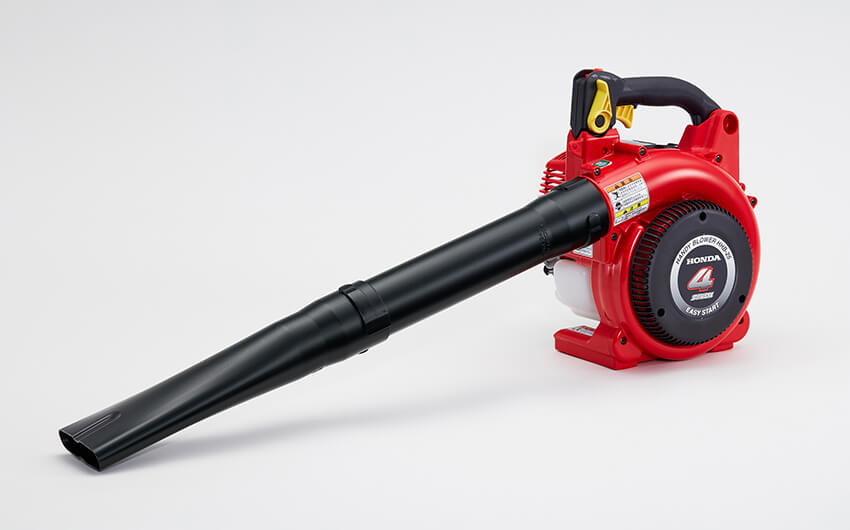
The Handy Blower HHB25
Sales of the M4-0 engine also expanded into the OEM market supplying other manufacturers. In addition to handheld power tools, this engine also found a wide range of applications, from household devices like compact tillers and water pumps to commercial devices like rammers. As of 2017, it’s been nearly 15 years since the GX25 and GX35 first debuted, yet these long-selling products continue to record over 700,000 units in sales each and every year.
As exemplified by Honda’s F150 Tiller, E300 Generator, and HR21 Lawnmower, the key to becoming the best seller in
any category is product development aimed not merely at the present, but also with a steady eye on conditions
that may arise more than a decade into the future. As the world’s lightest 4-stroke engines, the GX25 and GX35
clearly embody Honda’s vision for the future.